Nepal's laws affect you.
Your voice should too.
Nagarik Niti tracks bills through the legislative process, explains them in plain language, and turns your input into a structured report delivered to the people deciding, and keeps the record after they do.
Why this exists
Bills are decided in language most citizens can't read, on timelines they never see, with no real way to respond.
Dense, technical text
Bills are rarely available in plain Nepali, so most citizens can't read what's actually being decided.
No real way to respond
Comment windows are short, poorly publicized, and effectively closed to anyone outside institutional circles.
No visible link to existing law
Bills amend and build on laws already in place, and tracing that connection takes legal expertise most citizens and CSOs don't have.
"In 2019, the Guthi Bill was withdrawn only after mass street protests, not structured consultation. The civic will was always there. What's missing is accessible infrastructure."
What Nagarik Niti does
Four modules, one path from a bill to your voice.
Policy Tracker
See exactly where a bill stands, from first registration to passage, updated continuously, not just during comment windows, and keeps every past version on the record, not just the current one.
AI-Assisted Summary Engine
Plain-language, bilingual summaries of what a bill proposes and who it affects, with every summary reviewed and signed off by independent human validators before publication.
Legal Reference Mapping
See which existing laws a bill changes, amends, or repeals, without needing a legal background to follow it.
Structured Input Tool
Answer guided questions on specific provisions, anonymously if you choose, and have your input aggregated into a formal citizen report delivered to the government body responsible, and stays part of the bill's public record even after the report is delivered.
Ongoing, not one-off
A public record of how Nepal's laws are made: one bill, then the next, then the next.
Every bill's history stays here: how its text changed at each stage, what citizens and CSOs said about it, and what became of their input. Nagarik Niti isn't a tool for one legislative session. It's a running record that keeps growing, bill after bill, term after term.
Bills come and go. The record doesn't.
How the pieces connect
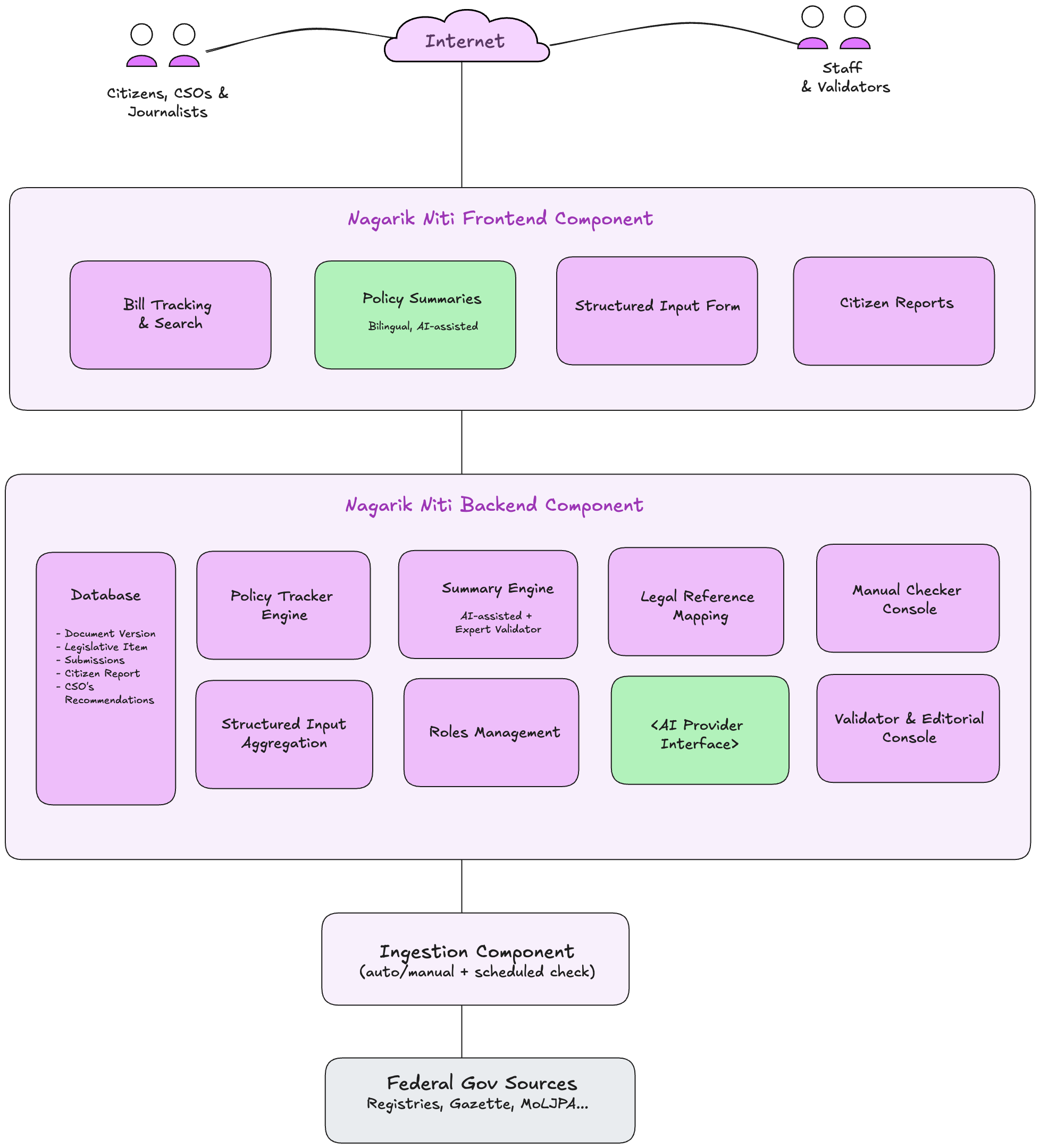
Citizens reach a frontend component (bill tracking & search, policy summaries, structured input, citizen reports) over the internet, backed by a backend component holding the database and the engines behind each module, with an ingestion component pulling bill text and status from government sources on a schedule.
See the full picture, including who talks to whom and how a summary gets drafted →
How we work
Descriptive, not advocacy. Independent, not official. Verified by people, not just machines.
AI-assisted, human-verified
Every summary is either AI-drafted or human-written, but it is never published without sign-off from independent validators. AI drafts a starting point, and people decide what's accurate.
We describe, we don't advocate
Summaries and legal mappings explain what a bill does. They don't tell you whether it's good or bad, and contested bills are presented with multiple perspectives, not one voice.
Independent of government
Nagarik Niti is built and maintained by a civil society organization, not a government body, which is a deliberate difference from official portals.
Built for
Who it's for
Built for this legislative session, and every one after it.
Get involved
Be the first to know when we launch.
Interested in becoming a validator or partner organization? Get in touch →